 ·
4 minute read
Delivering Defence Manufacturing Projects Without Compromising Production
Defence manufacturing is changing quickly. Demand is increasing, production capacity is under pressure and manufacturers are being asked to deliver more — often without the luxury of stopping operations while facilities are upgraded.
But increasing capacity isn't simply a matter of finding more space.
The way a facility is designed, phased and delivered can directly affect production, programme timescales, operational resilience and future growth.
Our latest white paper explores what this means for organisations planning defence manufacturing expansions, refurbishments and specialist facility projects.
It brings together current defence-industry developments with practical experience from technically demanding projects across defence, aerospace and advanced manufacturing.
What happens when the building becomes part of the production system?
For a conventional workplace, construction disruption might mean temporarily moving teams, working remotely or closing an area for a few weeks.
For a live manufacturing environment, the consequences can be very different.
A power upgrade can affect machinery.
A change to access routes can affect logistics.
A poorly sequenced construction phase can affect production.
A lack of future capacity can limit the return on today's investment.
So the real challenge isn't simply:
“How do we deliver the project?”
It's:
“How do we deliver the change while keeping the operation moving?”
That question sits at the heart of our latest white paper.
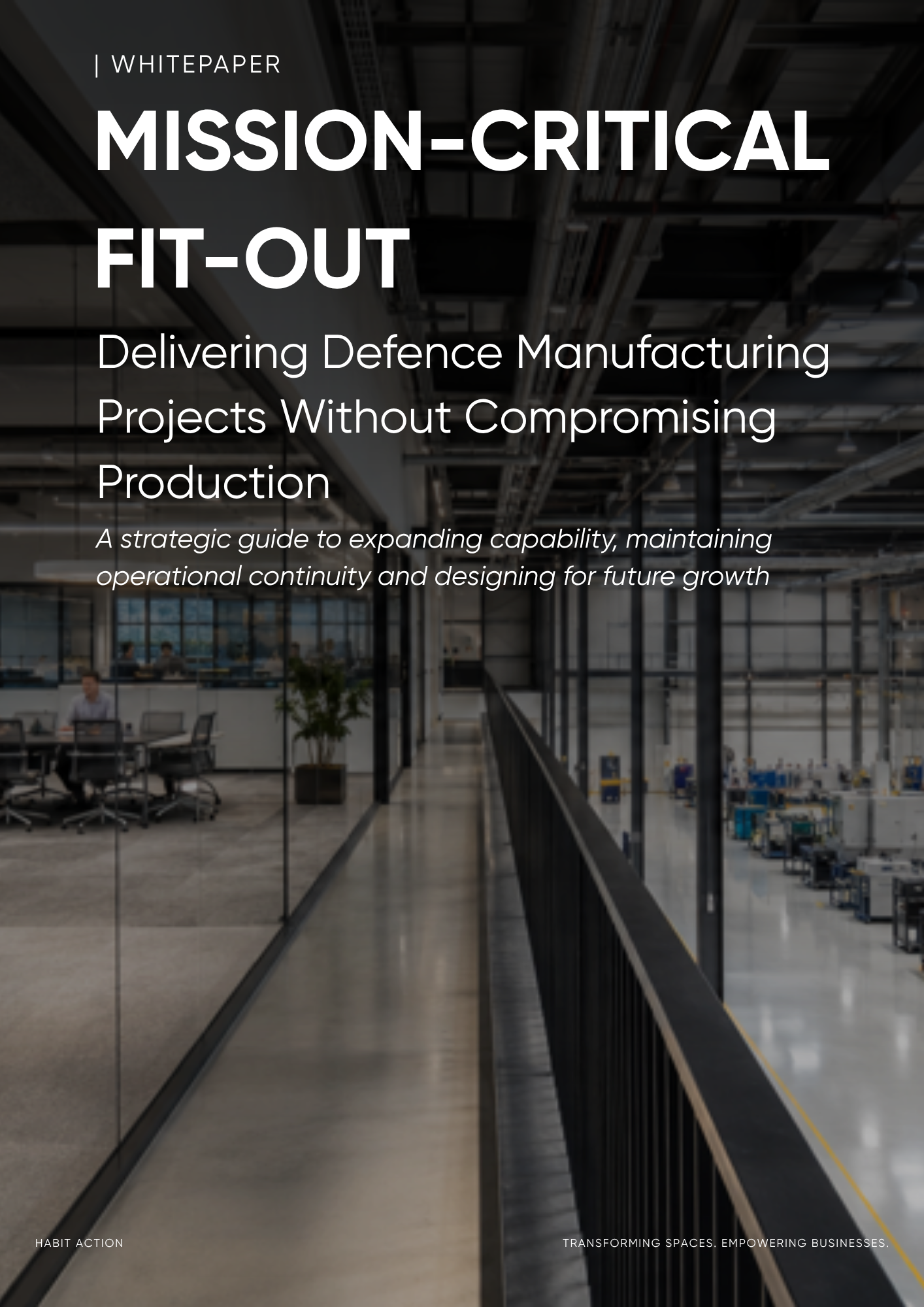
Inside the white paper
You'll discover practical thinking around:
Speed
How manufacturers can move from requirement to delivery without sacrificing technical or commercial rigour.
Operational continuity
How construction can be planned around live production and critical operations.
Manufacturing capacity
How the right facility design can create genuinely usable production capacity — not simply more floor space.
Security & specialist requirements
Why technical infrastructure and security need to be considered early, rather than added as an afterthought.
Future growth
How today's facility investment can provide the flexibility to accommodate tomorrow's equipment, processes and demand.
A practical perspective, backed by real projects
The white paper draws on project experience across defence, aerospace, advanced manufacturing and other technically demanding environments, including accelerated programmes and specialist facilities where the building has to work as hard as the operation itself.
It isn't a guide to building bigger. It's a guide to building capability.
Download Mission-Critical Fit-Out
Discover how to plan and deliver complex manufacturing projects without unnecessarily compromising production.
FAQs
What is a mission-critical fit-out?
A mission-critical fit-out is the design and construction of a facility where the building directly supports an operation that cannot afford to stop, such as defence manufacturing or aerospace production. Unlike a standard office fit-out, success is judged on two things: whether production keeps running while the works happen, and whether the finished facility adds real capability. The building is treated as part of the production system, not a container for it.
How can defence manufacturers expand capacity without stopping production?
By sequencing the works around the production schedule and identifying every live-site constraint before the design is fixed. That means mapping which services, access routes and machinery each phase will touch, then programming construction so critical lines stay powered and supplied throughout. Where a shutdown is genuinely unavoidable, it should be a planned window agreed with the operations team months in advance, never something discovered on site.
Why isn’t more floor space the same as more manufacturing capacity?
Because capacity depends on whether a space can support the process, not on its size. Floor loading, electrical supply, ventilation, controlled environments, material flow and security segregation all decide how much a facility can actually produce. A large hall without the power to run new machinery adds square metres but no output. The better question for any expansion is how much more the site can make, and how soon.
When should security be considered in a defence facility project?
At the very start, before any layout is agreed. Security requirements shape zoning, access control, IT and communications infrastructure, and even who is permitted on site during construction. Facilities handling classified work, such as List X sites in the UK, carry obligations that are costly or impossible to retrofit. Treating security as a late addition is one of the most common causes of redesign and delay on defence projects.
What are the biggest risks in a live manufacturing fit-out?
The biggest risks sit at the interface between construction and the live operation, rather than in the construction itself. Typical examples include unplanned power or utility interruptions, blocked logistics routes, contamination of controlled areas, and safety conflicts between contractors and production staff. Almost all of them trace back to incomplete early surveys or poor phasing, which is why the planning stage carries more weight on these projects than on almost any other fit-out.
How do you future-proof a defence manufacturing facility?
By building in headroom from day one: spare electrical capacity, adaptable services routes, structural allowance for heavier equipment, and layouts that can be reconfigured as processes evolve. Defence programmes run for decades, and the equipment a site needs in ten years may not exist yet. Paying a little more for flexibility now is almost always cheaper than a second disruptive refit later.
How quickly can a mission-critical fit-out be delivered?
Timescales depend on scope, but the fastest programmes share one trait: design, procurement and construction overlap under a single accountable team. Ordering long-lead items such as switchgear and specialist plant early removes one of the most common bottlenecks. Speed on these projects comes from removing decision delays and handovers, not from cutting technical or commercial rigour.
Why choose a design-and-build partner for a defence or advanced manufacturing project?
A design-and-build partner takes single-point responsibility for the facility, so operational risk is managed by one team from first survey to handover. Gaps between separate designers and contractors are where live-site risks tend to fall through. Habit Action delivers design-and-build fit-outs for defence, aerospace, advanced manufacturing and laboratory environments across the UK and EMEA.
What does Habit Action’s Mission-Critical Fit-Out white paper cover?
The white paper explains how to plan and deliver complex manufacturing projects without unnecessarily compromising production. It covers moving from requirement to delivery at speed, planning construction around live operations, creating genuinely usable production capacity, building security and specialist infrastructure in from the start, and designing for future growth. It draws on project experience across defence, aerospace and advanced manufacturing.